


Intent (Value): Give property managers and office decision-makers a repeatable, metro-ready operating system for consistent cleanliness across multi-site portfolios in Chicago–Naperville–Elgin (CHI), Indianapolis–Carmel–Anderson (IND), and Detroit–Warren–Dearborn (DET): without relying on heroics or micromanagement.
Social Caption (keyword CTA): Managing CHI/IND/DET properties? Steal this “cleanliness-at-scale” playbook: standards, phased turnovers, QC, and vendor rhythm. Keyword CTA: “SCALE” → https://maidhop.com/newsletter
Image prompt (no text on image): A modern commercial building lobby with a clipboard checklist on a counter, a supply caddy nearby, and a cleaning cart in the background, bright natural lighting, no people, no text.
Category tags: General Newsroom, Midwest (MW), PM (Property Management), Office, Operations, Quality Control
Metropolitan cleanliness is an operations problem (not a “try harder” problem)
If you manage one building, you can sometimes “muscle through” a rough week. If you manage a portfolio across CHI, IND, and DET: different vendors, different traffic patterns, different elevator situations: you can’t scale effort. You have to scale systems.
In Midwest metros, the most common breakpoints we see are predictable:
- Turnover compression: leasing wants it ready yesterday; maintenance is still in the unit; cleaners get blamed for dust that wasn’t theirs.
- High-touch drift: lobbies and restrooms look fine at 9 a.m. and rough by 2 p.m.
- Supply chaos: crews lose time hunting for keys, liners, paper goods, or the “right” floor chemical for the finish.
- QC inconsistency: the building “looks clean” until a resident points out the same corner every week.
The fix is boring (in a good way): documented standards, phased processes, and quality checks that operate even when you’re not on-site.
Step 1: Define “clean” like you mean it (standards that survive turnover)
Most cleaning scopes fail because they’re written like vibes:
- “Clean kitchen.”
- “Wipe surfaces.”
- “Bathroom detail.”
That’s not scalable. In a multi-site portfolio, “clean” must be specific enough that two different crews produce the same result.
Your standards should answer three questions
- What gets cleaned (inventory of surfaces and fixtures)
- How it gets cleaned (method + dwell time + tools)
- What “done” looks like (verifiable outcomes)
A simple way to tighten standards fast: rewrite vague lines into action + method + measurable finish.
Instead of: “Clean oven.”
Use: “Remove racks, apply degreaser, dwell 15 minutes, scrub interior and door, wipe exterior handles and knobs until no visible residue remains.”
Instead of: “Wipe glass.”
Use: “Glass cleaned edge-to-edge with streak-free finish under lobby lighting; fingerprints removed from entry doors, vestibule panels, and sidelight panes.”
The metro reality: light makes or breaks perception
In CHI high-rises with bright lobby glazing, streaks show immediately. In DET winters, salt haze and vestibule glass get ugly fast. Your standard should include what’s visible under the lighting your building actually has: not what looks okay in a dim corridor.
Deliverable to build once (and reuse everywhere):
- A one-page “Definition of Clean” per area type: lobby, elevator, restroom, fitness room, hallways, trash rooms, loading dock.
- A unit-turn standard per unit type (studio/1BR/2BR), including appliance expectations.

Step 2: Run turnovers in four phases (and stop paying twice)
In Midwest portfolios, the #1 turnover cost leak is cleaning happening before maintenance is done. It creates rework, delays, and a weird blame loop.
Use a four-phase turnover process that keeps everyone honest and keeps the schedule predictable.
Phase 1: Initial inspection (15 minutes that saves hours)
Walk the unit with a checklist before any work starts. Document with photos:
- damage vs. wear
- missing fixtures
- appliance issues
- odors, pests, or moisture flags
This is where you prevent: “Was that scratch already there?” and “Why did this take so long?”
Tip for scale: standardize a photo set (same angles every time). It’s faster than you think once it’s routine.
Phase 2: Repairs and maintenance (do this before cleaning)
Maintenance creates dust and debris. If you clean first, you’re buying a redo.
Common Midwest turnover sequencing problems:
- HVAC filter swap after cleaning (dust on floors)
- paint touch-up after cleaning (roller flecks)
- plumbing fix after cleaning (water spots, caulk mess)
Phase 3: Deep cleaning (uninterrupted, checklist-driven)
Now the unit can be cleaned without stop-start distractions. Your checklist should include:
- high dusting (tops of cabinets, vents)
- bathroom detail (grout lines, behind toilet base)
- appliance interior finish expectations
- floor finish expectations (no sticky spots, no visible edge buildup)
Phase 4: Final verification (fresh eyes)
The best QC is simple: the person verifying should not be the person who cleaned. Use a shortened checklist focused on:
- top 10 miss zones (baseboards, corners, faucet bases, mirror edges, under-sink, behind toilet)
- photo verification for “problem children”
- anything that triggers resident complaints
This should take 20–30 minutes, not an hour-long inspection theater.
Step 3: Build schedules that match metro traffic (daily/weekly/monthly tiers)
A portfolio schedule needs to reflect how the building lives, not how a scope sheet was copied and pasted.
Daily (high-traffic, high-visibility)
Best for: CHI office lobbies, IND medical-adjacent offices, DET mixed-use entries
- vacuum entry mats; shake out where applicable
- sweep/mop lobby floors (watch winter salt lines)
- wipe high-touch points (door handles, push plates, elevator buttons, restroom touchpoints)
- empty common area trash and replace liners
- restock paper goods and soap where required
- spot clean obvious smudges on interior glass
Weekly (presentation reset)
- full glass cleaning in lobby/vestibule
- dust ledges, railings, and visible horizontals
- spot clean walls and baseboards (especially near elevators)
- mop hard-surface hallways multiple times as needed (portfolio decision: 1x vs 2–3x)
- polish fixtures where applicable (don’t turn this into a time sink)
Monthly (deep detail + prevention)
- tile/grout detail in restrooms and amenity areas
- high dusting (vents, tops of door frames)
- vent cover cleaning
- baseboard detail passes
- exterior touchpoints: entry pads, loading areas, dumpster surrounds (power washing where appropriate)
Operations note: Don’t let “monthly” become “when someone complains.” Put it on a calendar and tie it to an inspection route.
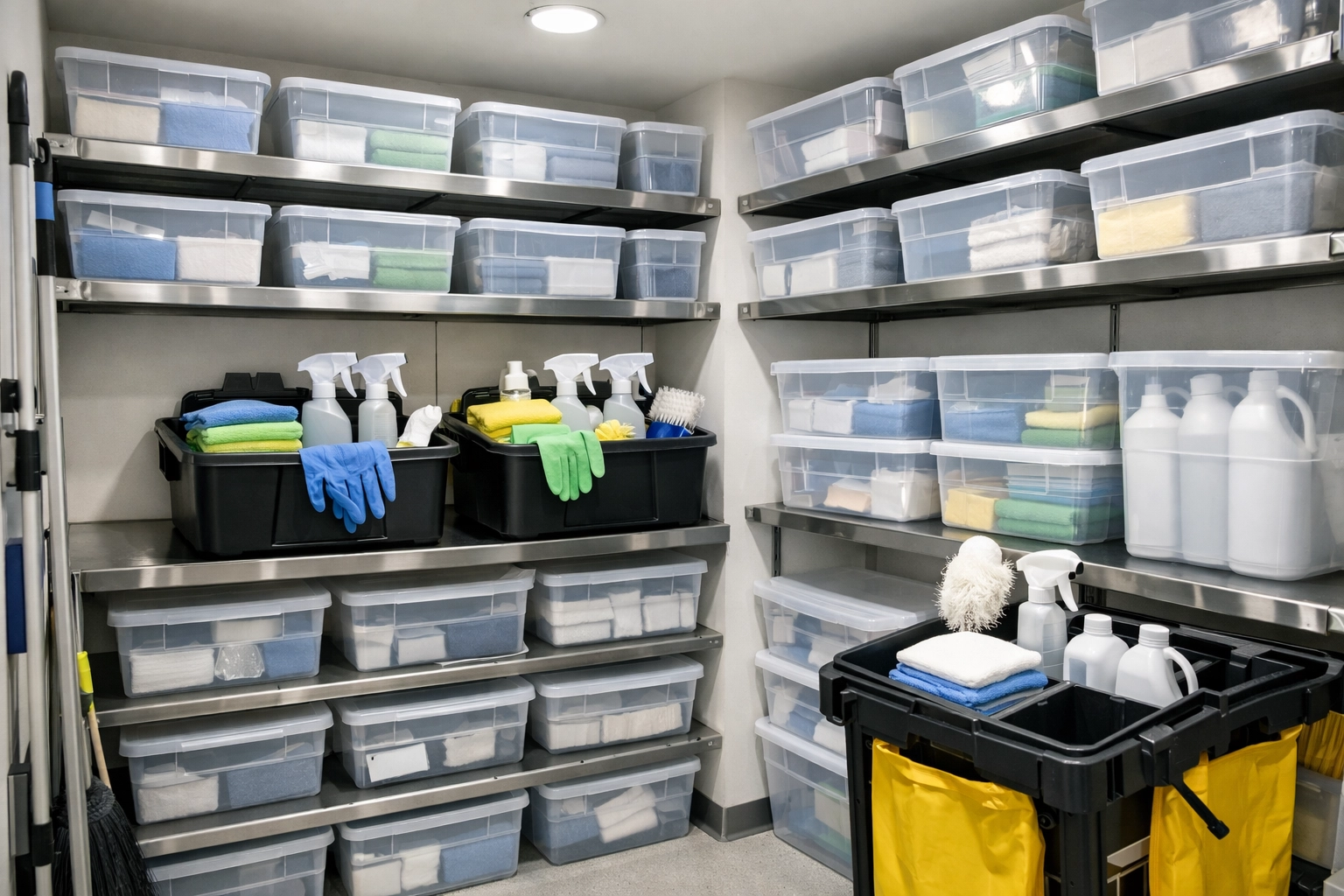
Step 4: Stop the supply scramble (pre-packed kits + controlled storage)
At scale, “missing supplies” becomes a hidden tax. If each visit loses 10 minutes to a supply hunt, that’s real money across dozens of sites.
Standardize pre-pack kits by task
Build kits so a crew can grab-and-go:
- all-purpose cleaner
- glass cleaner
- disinfectant for approved surfaces and use cases (follow label instructions)
- floor cleaner matched to your finish type
- bathroom cleaner
- microfiber cloths (color-coded if you want fewer cross-use mistakes)
- scrub brushes, grout brush, scraper tool
- bags/liners sized to the bins onsite
Store kits:
- centrally (for route-based teams), or
- in a locked janitor closet with a simple par-level sheet
Midwest-specific friction: older buildings in DET and CHI can have tiny closets and odd sink setups. If storage is limited, standardize a mobile caddy + locked tote approach.
Step 5: Add “maintenance eyes” without turning cleaners into techs
You don’t want your cleaning provider performing repairs. You do want them spotting issues early so you can dispatch maintenance before it becomes an emergency.
Add a light “see-and-report” check during cleaning visits:
- HVAC filter looks overdue
- leaks under sinks, around toilets, or behind water heaters
- water pressure drops or slow drains
- outlets loose or faceplates missing
- pests or droppings (report, don’t diagnose)
- damaged door sweeps (winter drafts show up as resident complaints fast)
This creates a steady stream of small saves:
- fewer after-hours calls
- fewer resident escalations
- fewer “why wasn’t this caught earlier?” moments
Step 6: Quality control that scales (short checklist + trending)
If your QC process is too long, it won’t happen. If it’s too vague, it won’t work. The scalable middle is a short, repeatable inspection plus trend tracking.
A practical QC model for CHI/IND/DET portfolios
- Per site, per week: 1 abbreviated inspection (20–30 minutes)
- Per month: 1 deeper inspection (amenities + back-of-house)
- Per quarter: 1 standards reset (walk with provider, refresh expectations)
What to track (keep it simple)
Track only what helps you prevent repeats:
- top 5 recurring misses (by site)
- response time to issues
- rework frequency (callbacks per month)
- problem zones (trash room, stairwell, vestibule)
When the same item appears 3 times, it’s not a “crew issue.” It’s a process issue:
- unclear standard
- wrong tool/chemical
- insufficient time allocation
- access problem (locked door, missing key)
- schedule mismatch (traffic peaks)
Midwest bottlenecks: what breaks at scale in CHI vs IND vs DET
You can run one playbook across all three metros, but you should anticipate different stress points.
Chicago–Naperville–Elgin (CHI): density + glass + winter salt
- Lobby glass and vestibules are perception drivers.
- Elevator cabs get hit hard; fingerprints show fast.
- Winter salt turns into a constant floor battle: entry mat strategy matters.
Ops fix: add “salt-line response” to daily scope in winter months and confirm floor cleaner compatibility with your finish.
Indianapolis–Carmel–Anderson (IND): spread-out routes + mixed building types
- Drive time impacts reliability if routes aren’t planned.
- Many portfolios mix office + light industrial + medical-adjacent spaces.
Ops fix: lock in start windows and build route density; standardize checklists so different site types don’t create scope confusion.
Detroit–Warren–Dearborn (DET): older infrastructure + back-of-house realities
- Trash rooms, loading areas, and stairwells are where cleanliness perception can collapse.
- Storage constraints and older finishes need the right chemicals and tools.
Ops fix: explicitly scope back-of-house and define floor-care do’s/don’ts for older finishes to avoid damage and rework.
What “operational reliability” looks like (the vendor rhythm property managers actually need)
At portfolio scale, you’re not buying “cleaning.” You’re buying predictability:
- consistent arrival windows
- clear communication when something is off
- repeatable outcomes across sites
A reliable operational cadence looks like:
- Weekly: confirmed schedule + exceptions logged (closures, events, access changes)
- Monthly: QC summary + top issues + corrective actions
- Quarterly: walkthrough + scope tune-up for seasonal changes (winter entryways, spring construction dust, etc.)
If you’re constantly re-explaining expectations, the system isn’t built yet.
Where MH Janitorial fits in (simple: systems, not surprises)
MH Janitorial supports property managers and offices by focusing on process-driven cleanliness: standards, phased work, supply control, and QC rhythm: so your sites don’t depend on luck or which crew happens to show up.
If you’re managing multiple buildings in CHI, IND, or DET and want fewer escalations and fewer “can someone swing by again?” messages, start by tightening the standards and QC loop. Then align your provider to that system.
Learn more about MH Janitorial: https://www.mhjanitorial.com
Sitemap (for quick navigation): http://mhjanitorial.com/sitemap.xml
The “Cleanliness at Scale” quick-start checklist (copy/paste for your next vendor call)
Use this as a 15-minute reset conversation:
- Do we have a written “definition of clean” for lobbies, restrooms, elevators, hallways, and amenities?
- Are unit turns run in phases (inspect → maintenance → deep clean → verify)?
- Is the final verification done by someone other than the cleaner?
- Do we have pre-packed supply kits and par levels (no supply scramble)?
- Are daily/weekly/monthly tasks aligned to building traffic and seasonality?
- Do we track top recurring misses and fix root causes (not just rework)?
- Do we have a weekly + monthly communication rhythm that doesn’t require chasing?
If you want more Midwest ops playbooks like this for PM and Office teams, subscribe: https://maidhop.com/newsletter