


Every day a rental unit sits empty, it’s not just a missed opportunity: it’s a direct hit to your bank account. In the property management world, "Speed to Market" is the only metric that truly dictates your success. If your turnover process is sluggish, or if a new tenant walks into a "cleaned" unit only to find dust on top of the fridge and hair in the tub, you’re already behind.
I’m Theresa Renee, and as a Portfolio Manager, I’ve seen how a bad turnover can derail an entire quarter’s projections. Whether you are managing a single-family home, a massive apartment complex, or a high-turnover Short-Term Rental (STR), the cleaning phase is the most critical link in your supply chain.
Here are 10 things you need to know about turnover cleaning services to protect your bottom line and keep your units filled.
1. The Real Cost of Vacancy (The "Daily Bleed")
Most managers look at the invoice from a cleaning company and think about how to lower it. That’s the wrong math. You should be looking at the cost of the unit sitting vacant.
If a unit rents for $2,400 a month, every single day it sits empty costs you $80. If your cleaning crew takes four days to get in there instead of one, you just lost $320. That is often more than the cost of the cleaning itself. A premium turnover service that guarantees 24-48 hour turnaround isn't "expensive": it’s a defensive play to stop the daily bleed.

2. Make-Ready vs. "Just a Clean"
There is a massive difference between a standard residential house cleaning and a professional turnover "make-ready." A make-ready clean is surgical. It’s about restoring the unit to a neutral, like-new state.
A true turnover service includes:
- Inside and behind all appliances (oven, fridge, dishwasher).
- The tops of cabinets and door frames (where dust hides).
- Detailed window tracks and baseboards.
- Deep cleaning of the "wet areas" (bathrooms/kitchens) until they are clinical.
If your cleaners aren't pulling out the fridge to sweep behind it, they aren't doing a turnover clean; they’re doing a surface wipe.
3. The 75% Industry Turnover Rate
The cleaning industry is notorious for high staff turnover. Some companies lose 75% to 300% of their staff every year. For you, this means inconsistency. One week you get a "Rockstar" crew, and the next week you get someone who has never held a mop before.
When hiring a nationwide commercial cleaning partner like MH JaniJournal, ask about their retention rates and training protocols. You want a partner that treats their cleaners like professionals, because stable staff means stable quality for your portfolio.
4. Maintenance Reporting: Your Eyes and Ears
Your cleaning crew is the only group of people who will spend 4–6 hours inside every square inch of your unit. They should be your primary source of maintenance intelligence.
A high-value turnover service doesn't just clean; they report. They should alert you if:
- There’s a slow leak under the sink.
- The HVAC filter is caked in dust.
- A window lock is broken.
- There are signs of "unauthorized" pets or smoking.
Detecting a $50 plumbing fix during a turnover prevents a $5,000 floor replacement three months later.

5. Standardizing Across the Portfolio
If you manage properties across different states or cities, the "mom-and-pop" approach to cleaning becomes a nightmare. You end up with five different invoices, five different levels of quality, and five different points of contact.
Using a centralized commercial cleaning service allows you to standardize the "Brand Standard." Whether the unit is in Chicago or Austin, the tenant gets the same experience. This consistency is what allows you to scale your portfolio without scaling your stress levels.
6. The Psychological "First Five Minutes"
The "Zero-Click" value for a property manager is understanding tenant psychology. A tenant decides if they love or hate their new home in the first five minutes. If they see a smudge on the light switch or a hair in the drawer, they immediately become "problem tenants." They will start looking for every other flaw in the building.
A pristine turnover clean sets the tone for the entire lease. It tells the tenant: "We care about this property, and we expect you to care about it too."

7. Short-Term Rental (STR) Requirements
For my STR hosts out there, turnover cleaning isn't just about "clean": it’s about hospitality. You are competing with hotels. This means:
- Perfectly staged linens and towels.
- Replenishing consumables (coffee, toilet paper, soap).
- A "hotel-tight" bed tuck.
Your bottom line in the STR world is tied directly to your star rating. One bad review about a "dirty bathroom" can drop your occupancy by 20% overnight. Investing in a specialized turnover service is essentially an insurance policy for your 5-star rating.
8. Managing the "Hidden" Costs: Supplies and Equipment
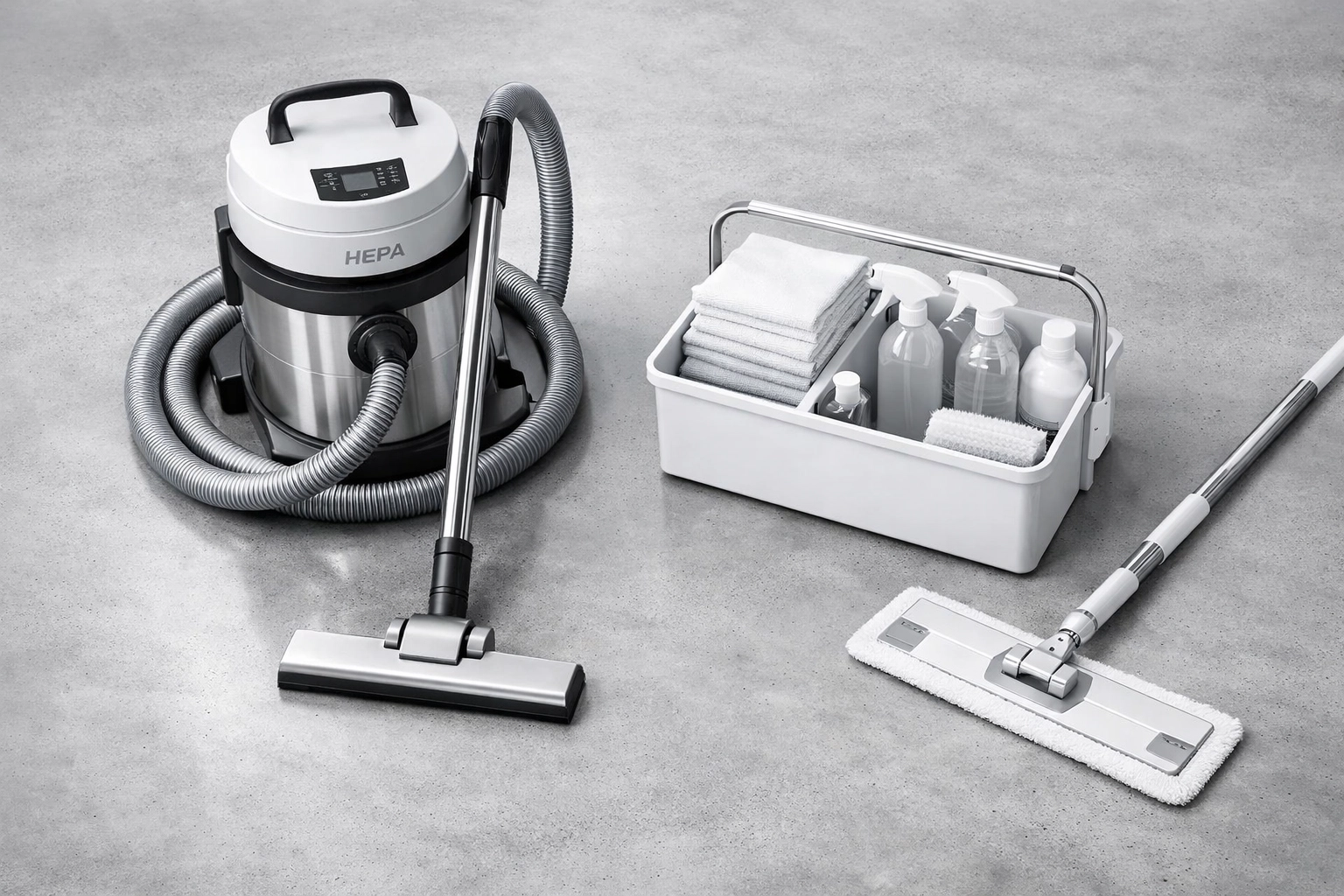
When you use a professional service, you shouldn't be providing the vacuum, the chemicals, or the rags. A professional outfit brings their own commercial-grade HEPA vacuums and EPA-approved disinfectants.
If you are currently buying cleaning supplies for your in-house staff, you’re likely overpaying due to waste and theft. Outsourcing to a flat-rate service makes your costs predictable. You know exactly what a 2-bedroom turnover costs every single time.
9. Speed-to-Market and the "Pre-Lease"
In a hot market, you want to be able to show a unit while the previous tenant is moving out, or immediately after. A professional cleaning crew can work in tandem with your painters and flooring contractors.
We recommend a "Pre-Clean" for showings and a "Final Touch" right before move-in. This keeps the unit looking sharp even if it sits for a week during the leasing process. Check our lander for more tips on coordinating these high-speed transitions.
10. Liability and Insurance
This is the boring part that protects your bottom line the most. If a "neighborhood cleaner" slips in your unit or accidentally floods a bathroom by leaving a tap on, are they insured? If not, you are.
A professional commercial cleaning partner carries General Liability, Workers' Comp, and Umbrella policies. This removes the risk from your shoulders. Protecting your bottom line isn't just about making money; it's about not losing it to a lawsuit or a preventable accident.

Summary of Value for Each Category
For Property Managers (PMs)
- Focus: Speed to market and scalability.
- Action: Standardize your turnover checklist and move to a centralized vendor to reduce administrative overhead. Every day saved in turnover is an extra 3% of monthly revenue captured.
For Short-Term Rental (STR) Hosts
- Focus: Reviews and hospitality.
- Action: Hire a service that understands "staging" and "inventory management." Your cleaner is your most important boots-on-the-ground partner.
For Homeowners
- Focus: Asset protection.
- Action: Treat your home like a business. A deep turnover clean between tenants prevents long-term grime build-up that devalues your kitchen and baths.
The Bottom Line
Turnover cleaning is the unsung hero of real estate investment. You can have the best marketing and the best location, but if the product (the unit) is dirty, you will lose high-quality tenants and settle for low-quality ones.
Stop thinking of cleaning as an expense and start thinking of it as a revenue-acceleration tool. When you cut down the time between "Move-Out" and "Move-In," you aren't just cleaning a room: you’re optimizing your cash flow.
If you’re ready to see how professional, nationwide turnover services can change your workflow, take a look at our sitemap to find the services right for your region. Stay simple, keep it fast, and protect that bottom line.