


Categories: Property Management, Make-Ready Cleaning, Apartment Turnovers
Every day a unit sits vacant costs you money. The average property loses $50-$100 per day in rental income during turnovers. For a portfolio of 50 units with even a modest 30-day turnover time, that's $75,000-$150,000 in lost revenue annually. Speed matters, but cutting corners on quality creates longer vacancies down the road when prospects walk through a half-ready unit.
The good news? You don't have to choose between speed and quality. The fastest turnovers happen when you work smarter, not faster.
The Sequential Mistake Most Property Managers Make
Here's the typical turnover timeline: inspection on Monday, schedule repairs for Wednesday, wait for contractors Thursday, clean Friday, stage the following week, then finally list the property. That's 10-14 days minimum before anyone even sees your listing.
This sequential approach kills your speed-to-market. While you're waiting for the plumber to fix that leaky faucet, the entire unit sits idle. Meanwhile, your competitor down the street just listed a similar unit.
The solution is parallel workflows: running multiple tasks simultaneously instead of one after another.

The Parallel Workflow Approach
Start by dividing your turnover tasks into two categories: those that block other work and those that don't. Then attack them simultaneously.
Day 1: Complete Your Inspection
Walk the unit with your cleaning team, maintenance crew, and a detailed checklist. Document everything in one go. Take photos of damage, note needed repairs, and identify cleaning priorities. This single walkthrough gives everyone their marching orders at once.
Focus your inspection on these critical areas:
- HVAC, plumbing, and electrical systems
- Kitchen appliances and fixtures
- Bathroom functionality
- Flooring and wall conditions
- Windows, doors, and locks
- Safety devices (smoke detectors, carbon monoxide alarms)
Days 2-3: Launch Everything At Once
Here's where the magic happens. Don't wait for repairs to start cleaning. While your electrician replaces outlets in the living room, your cleaning crew can deep clean the kitchen. While the plumber works on bathroom fixtures, cleaners can tackle the bedrooms.
Professional cleaning teams know how to work around contractors. It's not about staying out of each other's way: it's about coordinating movement through the space.

The 48-Hour Deep Clean That Doesn't Wait
Deep cleaning shouldn't be your final step: it should happen in parallel with repairs. Target the areas that prospects care about most: kitchens and bathrooms.
Kitchen priorities:
- Degrease all appliances inside and out
- Clean oven, refrigerator, and dishwasher thoroughly
- Scrub countertops, backsplash, and sink
- Wipe down cabinets inside and out
- Clean light fixtures and switch plates
Bathroom priorities:
- Remove all soap scum, hard water stains, and mildew
- Deep clean toilets, tubs, and showers
- Polish all chrome fixtures
- Clean mirrors and medicine cabinets
- Scrub tile grout and refresh caulking if needed
The rest of the unit gets attention too: baseboards, light fixtures, ceiling fans, window tracks, and inside all closets. But kitchens and bathrooms are non-negotiable because they're deal-breakers for prospects.
The Quality Checks That Actually Speed Things Up
Quality control doesn't slow you down when built into your process correctly. Create a shared digital checklist that contractors, cleaners, and management can access in real-time.
Your quality checklist should include:
- All appliances tested and functional
- All faucets, toilets, and drains working properly
- All outlets and light switches operational
- HVAC system running efficiently
- Fresh paint touch-ups where needed (not always full repaints)
- All flooring cleaned or replaced
- Windows opening, closing, and locking properly
- New locks installed
- Smoke and carbon monoxide detectors tested
Here's the key: assign one person: typically your lead maintenance tech or trusted vendor: to complete this final walkthrough before you do. They catch 90% of issues before you ever step foot back in the unit. You're not eliminating quality checks; you're making them more efficient.

The Staging Decision: Fast vs. Fastest
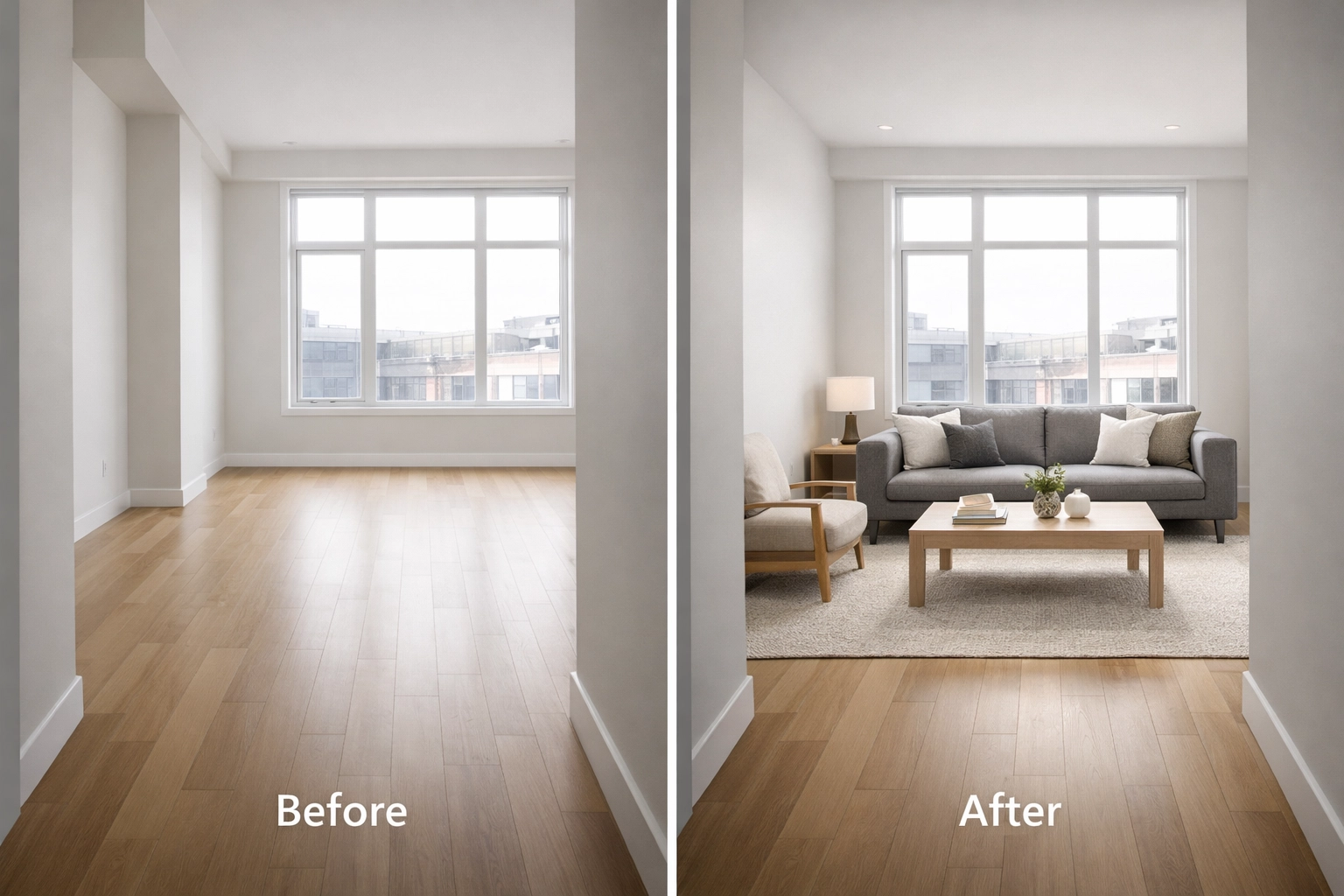
Properties in good repair and professionally staged rent 73% faster than unstaged units. But traditional staging takes time: coordinating furniture delivery, arranging pieces, adding accessories.
For speed-to-market properties, consider these options:
Virtual staging lets you list immediately with furnished photos while showing the actual empty space in person. It costs a fraction of physical staging ($50-$150 per room vs. $2,000+ monthly) and adds zero time to your turnover.
Minimal physical staging focuses only on high-impact pieces. A couch in the living room, a bed in the master, a table in the dining area. Five pieces of furniture that take two hours to place but triple your showing requests.
No staging works if your unit is in excellent condition, freshly cleaned, and well-lit. Make sure you're taking professional photos with natural light and decluttered spaces.
Choose based on your market. Competitive markets with longer average days-on-market benefit most from staging. Hot markets where units rent in days might not need it.
The Numbers That Matter
Let's talk about what speed-to-market actually means for your bottom line.
A 5-day turnover vs. a 15-day turnover saves you 10 days of vacancy. On a $1,500/month unit, that's $500 directly to your NOI. Multiply by 50 units turning over twice annually, and you've just added $50,000 to your property's net operating income.
But there's another number that matters: quality. Units prepped correctly command 2-5% higher rents and attract more qualified tenants. That same $1,500 unit rented at even 3% higher becomes $1,545: an extra $540 annually per unit, or $27,000 across your portfolio.
Speed gets the unit rented. Quality gets it rented for more to better residents who cause fewer problems.
The Make-Ready Checklist You Can Actually Use
Here's your actionable 5-day timeline for a standard turnover:
Day 1: Complete full inspection with all vendors present. Create punch list. Order any needed appliances or materials.
Day 2: Begin repairs and deep cleaning simultaneously. Focus on kitchens, bathrooms, and any blocking repairs first.
Day 3: Continue repairs and cleaning. Complete HVAC service and carpet cleaning if needed. Touch up paint.
Day 4: Finish all remaining work. Complete quality checklist. Install new locks. Test all systems.
Day 5: Final walkthrough. Professional photos. List property.
This works for 80% of standard turnovers. Add time for major repairs or renovations, but keep the parallel workflow approach.
When to Call in the Professionals
Some property managers try to save money by handling turnovers in-house with maintenance staff. Here's the reality: your maintenance team is great at repairs, but professional cleaning crews specialize in make-ready work.
Professional cleaning teams work faster because they do this every day. They have industrial equipment, proven processes, and teams that move through units systematically. What takes your maintenance person 2 days takes them 4-6 hours.
The math is simple. Paying $300-$500 for professional make-ready cleaning on a $1,500/month unit saves you 1-2 days minimum. That's $50-$100 in avoided vacancy costs, plus your maintenance team stays focused on repairs that actually require their skills.

The Bottom Line on Fast, Quality Turnovers
Speed-to-market isn't about rushing: it's about eliminating waiting. Every hour your unit sits ready but unlisted is lost revenue. Every day between tasks adds up to weeks of unnecessary vacancy.
The fastest turnovers happen when you:
- Coordinate all vendors and crews from day one
- Run cleaning and repairs in parallel, not sequence
- Focus quality checks on what prospects actually care about
- Choose staging strategies that match your market
- Use professionals for specialized work
Your goal is simple: get units rent-ready in 5-7 days without cutting corners that cost you rent premium or resident quality. It's possible when you treat turnovers as a coordinated operation instead of a checklist of sequential tasks.
Every day you shave off your average turnover time flows directly to your NOI. The property managers winning in competitive markets aren't working harder on turnovers; they're working smarter.