


Category: Property Management
Here's the thing about apartment turnovers: every day a unit sits empty is money walking out the door.
The average turnover takes 5-7 days, but most property managers are still doing things the old way: calling one person, waiting for them to finish, then calling the next person. Meanwhile, that vacant unit is costing you $50-100 per day in lost rent.
Let's talk about how to actually cut that time in half without sacrificing quality.
Why Most Turnovers Take Forever
Before we get into solutions, let's be honest about what's slowing you down.
You're probably dealing with:
- Waiting for your maintenance guy to finish repairs before the cleaners can start
- Playing phone tag with different contractors
- Discovering things weren't done right during the final walkthrough
- Cleaning crews that show up and realize they can't work because repairs are still happening
It's a coordination nightmare. And every delay means another day of vacancy costs eating into your NOI.

The Framework That Actually Works
The make-ready framework that high-performing property managers use isn't complicated. It's about three things: standardization, coordination, and speed-to-market.
Step 1: Get Everything in Writing
Stop relying on people's memory or "how we've always done it."
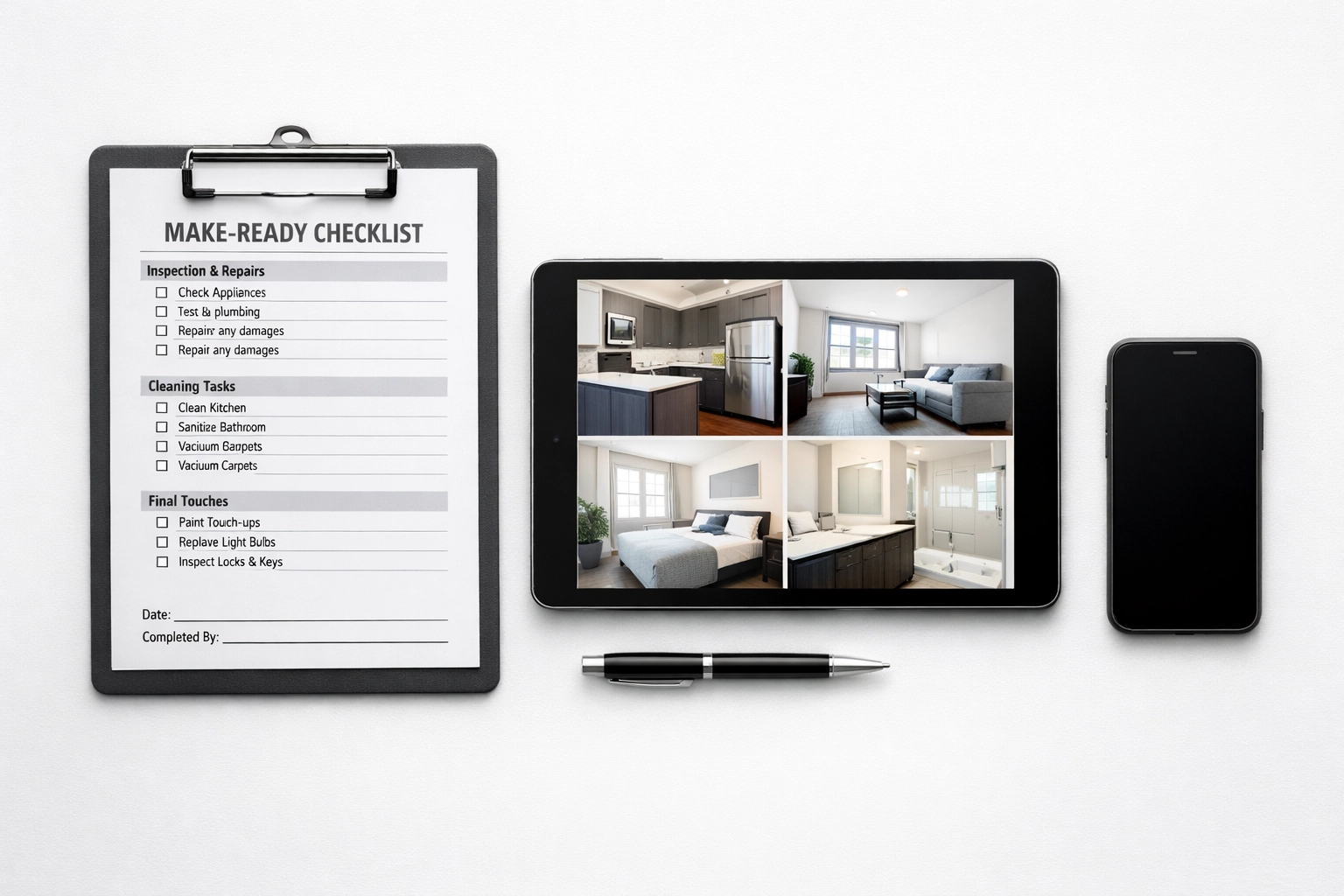
Create a written make-ready checklist that covers:
- HVAC filter replacement and service
- Smoke detector testing
- Fresh caulk in bathrooms and kitchen
- All light fixtures cleaned and working
- Appliances functioning and spotless
- Paint touch-ups or full repaint
- Deep cleaning standards for every room
When everyone knows exactly what "ready" means, you eliminate the back-and-forth and the "I thought someone else was handling that" conversations.
This isn't micromanaging. It's setting everyone up for success.
Step 2: Run Things in Parallel, Not Sequential
This is where most property managers lose days.
Traditional approach:
- Day 1-2: Maintenance fixes stuff
- Day 3-4: Painters come in
- Day 5-6: Cleaners show up
- Day 7: Final inspection (finds issues, add 2 more days)
Better approach:
- Day 1: Maintenance handles repairs in bedrooms while painters work in living areas
- Day 2: Both finish up, cleaners arrive same afternoon
- Day 3: Final cleaning details and inspection
You're not asking trades to work on top of each other. You're strategically scheduling so different areas are worked on simultaneously.
But here's the catch: you need relationships with professionals who can respond quickly. That means having your maintenance team, painters, and cleaning company lined up before you need them, not scrambling when a tenant gives notice.
Step 3: Sequence the Work Properly
Even when running parallel work, sequence matters.
Always follow this order within each area:
- Repairs and maintenance first
- Painting second
- Deep cleaning last
Why? Because you don't want your cleaning crew scrubbing floors only to have maintenance come in and track dust everywhere. And you definitely don't want to deep clean before painting.
The make-ready cleaning should be the final step that eliminates all traces of construction work and makes the unit show-ready.

Step 4: Bring in Professional Make-Ready Cleaners
Look, your maintenance guy might be great at fixing things. But asking him to also do a deep clean is slowing you down.
Professional make-ready cleaning teams show up with multiple people who can tackle different rooms simultaneously. What takes one person 8 hours takes a team of three just 2-3 hours.
Plus, they have:
- Industrial equipment that gets results faster
- Experience knowing exactly what needs attention
- Liability insurance (so you're protected)
- Quality standards with documentation
The cost is worth it when you factor in the vacancy savings. If a professional cleaning team costs $200 but gets your unit market-ready two days faster, you've saved money and can start showing the unit immediately.
The Final Walkthrough That Prevents Rework
Here's where a lot of property managers shoot themselves in the foot: they skip the detailed inspection.
Before you declare a unit ready:
- Walk through every single room with your checklist
- Open every cabinet and closet
- Test every light switch and outlet
- Run the faucets and flush the toilets
- Check the baseboards and corners
- Take photos or video of the finished condition
This takes 20 minutes but prevents the "I thought we cleaned that" conversation when you're about to show the unit to a prospect.
Document everything. It protects you if there are disputes with the cleaning crew, and it gives you proof of condition when the new tenant moves in.

Start the Clock Immediately
The framework only works if you actually implement it when someone gives notice.
As soon as you know a tenant is moving out:
- Schedule the maintenance assessment
- Alert your cleaning team about the upcoming turnover
- Coordinate timing with painters if needed
- Block off days in your calendar for the final walkthrough
Don't wait until move-out day to start planning. That's how you end up with a 10-day turnover instead of 3-4 days.
The properties with the fastest turnovers treat make-ready like a production line. They have systems, they have people on standby, and they execute the same framework every single time.
The Real Cost of Vacancy
Let's put this in perspective with real numbers.
If your average rent is $1,500/month, every day vacant costs you $50. A 7-day turnover costs $350 in lost rent. A 3-day turnover costs $150.
Over 20 units per year, that's a $4,000 difference in vacancy costs.
But here's what most property managers miss: speed-to-market also means you get first crack at quality tenants. When your units hit the market fast, you have more applicants to choose from. When you're slow, the good tenants have already found another place.
Fast turnovers = less vacancy + better tenant selection = higher NOI.
Your Next Steps
You don't need to overhaul everything tomorrow. Start with one thing:
Create your written make-ready checklist this week. Get specific about what "ready" actually means for your properties.
Then look at your last three turnovers. How long did each step take? Where were the delays? Who waited on whom?
Once you see the pattern, you'll know exactly where to focus. Maybe it's finding a reliable make-ready cleaning service. Maybe it's getting painters lined up in advance. Maybe it's just scheduling the inspection before all the work is done so you're ready to go.
The framework works. But only if you use it.
Want to see how professional make-ready cleaning fits into your turnover process? Check out what's possible when you have the right partners lined up.