


Category: Property Managers
Every day a unit sits vacant, you're burning money. Not just the obvious rent loss, we're talking utilities, marketing costs, and the pressure from ownership asking why occupancy dropped. The average property loses around $50-$100 per day per vacant unit. Multiply that across a 200-unit property with even a few stragglers, and you're looking at thousands gone each month.
Here's the thing: most make-ready delays aren't because of big disasters. They're death by a thousand cuts, waiting on paint delivery, hunting for the right air filter, crews showing up without knowing what needs done. The properties crushing their turn times? They've figured out how to eliminate these tiny delays that add up to weeks.
Let's get into the five strategies that actually work.
Step 1: Get a Dedicated Make-Ready Person (Yes, Really)
If you manage 100+ units, this is non-negotiable. Having your maintenance team juggle resident work orders AND turnovers means everything takes twice as long. Your tech gets halfway through a unit turnover, gets pulled away for a leaky faucet in building C, and suddenly that make-ready sits untouched for three days.
A dedicated make-ready technician stays focused. They're not answering service calls. They're not fixing someone's garbage disposal. They wake up knowing exactly which units need attention and can move through their punch list without interruption.
The ROI is simple math. If this role helps you turn units even 5 days faster, and each day of vacancy costs $75, that's $375 per turn. Run 40 turns a year? You just justified a full-time salary.

Step 2: Stop Playing Catch-Up, Prevent Issues Before Move-Out
Most properties treat make-ready like emergency surgery. The resident moves out, you discover the HVAC hasn't been serviced in four years, and now you're scrambling to find a vendor who can come this week.
Flip the script. Deal with predictable issues while people still live there.
Run these on a schedule:
- HVAC filter changes every 90 days (not "whenever")
- Annual HVAC system checks
- Quarterly plumbing inspections for leaks
- Appliance maintenance before they break
- Ceiling fan and fixture tightening twice a year
Yes, it's work upfront. But here's what changes: when someone gives notice, your turnover list shrinks dramatically. Instead of "replace broken dishwasher, fix HVAC that hasn't worked right in months, address that leak behind the toilet," you're down to paint and carpet cleaning.
One property manager told me they cut their average turn time from 18 days to 11 just by implementing quarterly preventive rounds. The units were already 80% ready when residents left.
Step 3: Standardize Everything (Seriously, Everything)
Walk through how your team currently handles turnovers. Bet you'll find every tech does it slightly differently. One starts with the kitchen, another with bathrooms. Someone uses contractor-grade paint, someone else grabs whatever's on sale. Nobody's quite sure where the extra outlet covers are stored.
This chaos costs you days.
Create a standard process:
- Same walk-through sequence for every unit type
- Identical paint brands and finishes (seriously, don't mix)
- Set order of operations (cleaning → repairs → paint → final clean)
- Designated storage spots for all supplies
- Clear handoff points between different trades
When your team can run the same play every single time, they get faster. No decisions to make, no hunting around, no "wait, how did we do this last time?"
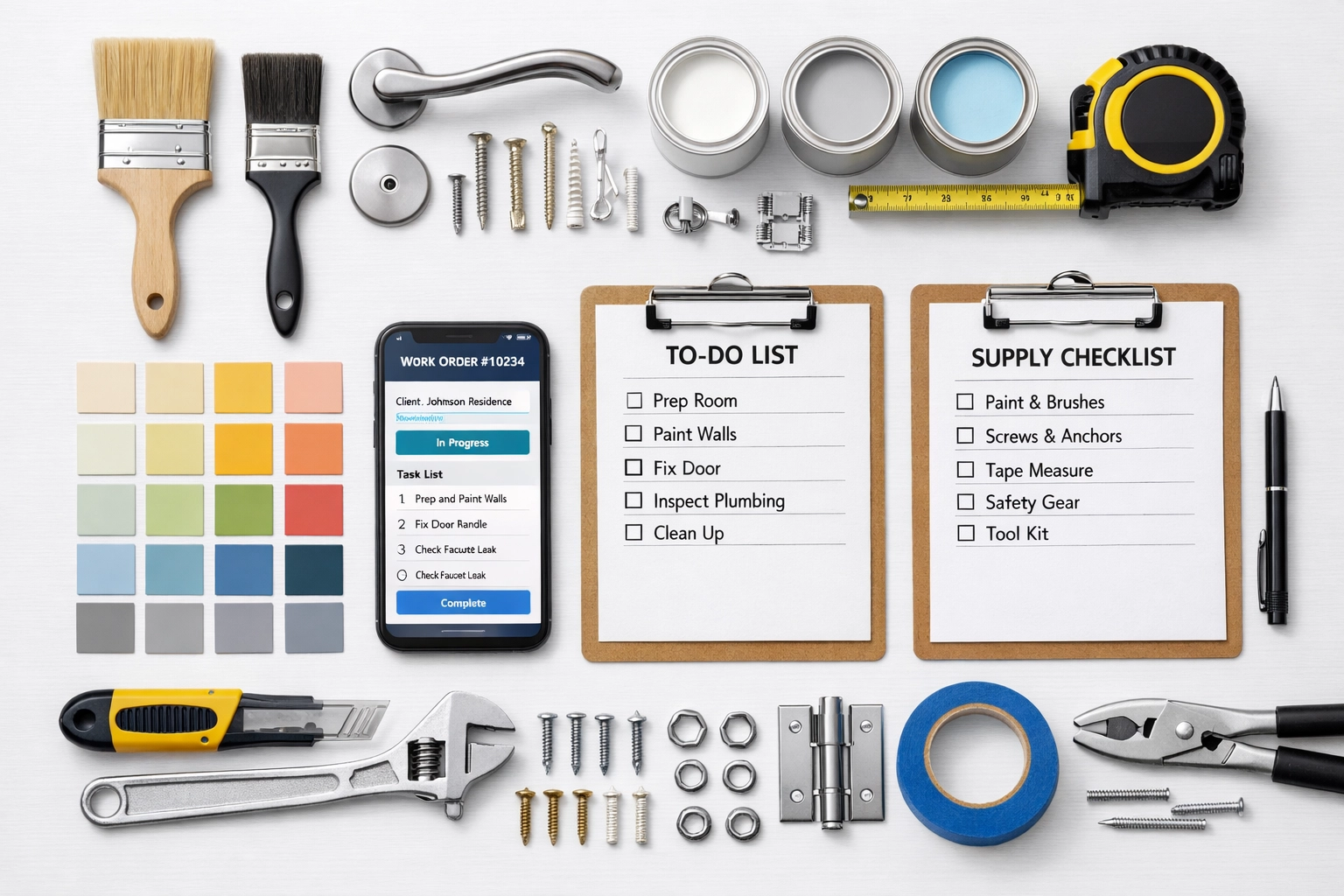
Look at where time disappears. Is your maintenance tech spending 30 minutes per turn just gathering tools and supplies? That's 20 hours a month gone. Set up a mobile make-ready cart with everything needed. They roll it to the unit and start working immediately.
Are vendors showing up confused about scope? That's on your work order system. Template it out. "Studio turnover" should trigger an automatic, detailed work order every single time.
Step 4: Keep a Make-Ready Inventory Closet
Nothing kills momentum like "we need to order paint" or "nobody grabbed new blinds." Maintenance has to stop, create a purchase order, wait for approval, wait for delivery, schedule a return trip. A 2-hour job just became a 4-day job.
Smart properties maintain a predictive inventory system. They know exactly what each floor plan needs because they've tracked it.
Stock these essentials:
- Paint (track gallons needed per unit type: a 2-bed typically needs X gallons of eggshell, Y gallons of semi-gloss)
- Air filters for every HVAC model in your property
- Light bulbs (all types you use)
- Switch plates and outlet covers
- Cabinet hardware
- Blinds (common sizes)
- Touch-up materials
Run the numbers on your last 20 turns. How many gallons of Agreeable Gray did you use across all 2-bedroom units? That's your baseline. Keep it stocked.
The upfront cost feels like a lot. But compare it to the carrying cost of vacant units. If predictive inventory shaves even two days off your average turn time, it pays for itself in one turn.
Step 5: Run Checklists Like Your Occupancy Depends On It (It Does)
You can't improve what you don't measure. And you can't execute consistently without documentation.
Every unit type needs its own comprehensive turnover checklist. Not a vague "clean and repair" list: a specific, room-by-room, task-by-task breakdown that leaves zero room for interpretation.
Your checklist should include:
- Each room with specific inspection points
- Who's responsible for each task
- Expected timeframes for completion
- Quality standards (what "clean" actually means)
- Sign-off requirements
Here's the real power move: track completion times for each task. When you know carpet cleaning consistently takes 4 hours but paint needs 2 days to dry between coats, you can schedule trades back-to-back with zero downtime.
Schedule the carpet cleaner to arrive the morning after the final paint coat. Have the final cleaning crew ready to go the afternoon after carpet dries. Every trade flows into the next with no gaps.
Property management software helps, but even a shared spreadsheet works if you're disciplined about updating it. The goal is visibility. You should be able to glance at your dashboard and know exactly which units are in play, what stage they're at, and if anything's running behind.

The Real Target: 7-10 Days
Industry standard for a basic turnover: no major damage, no renovations: should land between 7-10 days. If you're consistently running 14+ days, these five steps will get you there.
And here's why it matters beyond the obvious rent loss: speed to market is everything right now. The properties that can show a fresh unit while prospects are still hot? They're signing leases at asking price. The ones that say "it'll be ready in three weeks"? Prospects ghost and go somewhere else.
Vacancy costs compound. Every day you're late is another day of lost rent you'll never recover. But it's also another day marketing costs keep running. Another day utilities are burning. Another day your occupancy metrics look worse to ownership.
The properties winning right now aren't necessarily spending more on turns: they're spending smarter and moving faster. They've eliminated the small delays that don't feel like a big deal individually but add up to weeks of lost time.
Start with one of these five steps. Track your current average turn time, implement the change, and measure again in 60 days. Then add another. By this time next quarter, you'll be the property manager everyone else is trying to figure out.
Your turns don't need to be perfect. They need to be fast and consistent. That's the game.