


Every day a unit sits empty, you're bleeding money. The average vacancy costs property managers $40-60 per day in lost rent, not counting utilities you're still paying for an empty unit. If your average turnover takes 14 days, that's $560-840 gone before your next tenant moves in.
The good news? Most property managers can cut that time in half without hiring an army of contractors or spending a fortune. Here's exactly how to do it.
The Real Problem with Slow Turnovers
Most turnovers drag on because of three things: confusion about who's doing what, maintenance teams juggling too many priorities, and trades showing up in the wrong order (or not showing up at all).
When your maintenance tech is splitting time between emergency work orders and trying to turn a unit, the turnover always loses. When painters show up before maintenance finishes repairs, you lose days rescheduling. When no one person owns the entire process, units fall through the cracks.
Sound familiar?

Strategy #1: Get One Person Focused on Turnovers
This is the single biggest game-changer: designate someone whose main job is unit turns, not general maintenance, not emergencies, just turnovers.
If you can't afford to hire someone new, reassign responsibilities so one person on your team focuses primarily on make-ready work during peak turnover seasons. This dedicated role means units move through the process faster because someone's actually pushing them forward every single day.
When a make-ready tech isn't constantly pulled away to fix a leaky faucet in Building C, they can:
- Complete walk-throughs faster
- Coordinate with vendors directly
- Keep the entire process moving without interruption
One property manager we know cut her average turnover from 18 days to 9 just by making this one change.
Strategy #2: Fix Things Before They Break
Here's a counterintuitive truth: spending more on maintenance throughout the year actually speeds up turnovers.
When you schedule preventive maintenance for HVAC systems, appliances, plumbing, and hardware while units are occupied, you remove these items from your turnover checklist. Your make-ready team doesn't discover a broken garbage disposal on move-out day because you replaced it six months ago during routine maintenance.

Schedule these checks while units are occupied:
- HVAC filter changes and system servicing (quarterly)
- Appliance maintenance and replacements (annually)
- Plumbing inspections (annually)
- Hardware checks, cabinet hinges, door handles, locks (as needed)
Yes, this costs money upfront. But it prevents the expensive emergency situations during turnovers when you're racing against the clock to get a new tenant in. It's the difference between a planned $200 HVAC repair and a rushed $500 emergency call.
Strategy #3: Create Decision-Making Standards
Your maintenance team shouldn't waste time wondering whether a small wall scuff needs touch-up paint or a full repaint. Those decisions slow everything down.
Create clear standards for common situations:
- Minor wall marks = spot touch-up only
- Damage larger than a dinner plate = full wall repaint
- Carpet stains under 3 inches = professional cleaning
- Larger stains or multiple spots = carpet replacement
Use your historical data to guide these standards. If you always end up repainting kitchens anyway, make that the standard and save your team the decision-making time.
When everyone knows the playbook, units move faster.
Strategy #4: Get Your Trade Sequence Right
This is where most turnovers lose days unnecessarily.
The correct sequence is always:
- Deep cleaning and trash-out
- All maintenance repairs
- Painting and flooring work
- Final cleaning and detailing
- Final walk-through

When cleaning happens before repairs, you'll need to clean again. When painting happens before plumbing fixes are complete, you'll repaint. Every time the sequence gets scrambled, you add 2-4 days to your timeline.
Here's how to prevent sequence chaos:
Assign one person to coordinate all trades for each unit. This could be your make-ready tech or a property coordinator. They schedule everyone in the right order and make sure Trade A finishes before Trade B shows up.
Schedule trades back-to-back whenever possible. If maintenance wraps on Tuesday afternoon, painters should start Wednesday morning: not the following Monday. Those lost days between phases add up fast.
Strategy #5: Standardize Your Materials
Know exactly how much paint you need for a 2-bedroom versus a 3-bedroom. Keep those materials stocked.
Track what you use for each floor plan, then buy in bulk. When your team knows exactly what's in stock and where to find it, they're not making emergency runs to the hardware store mid-project.
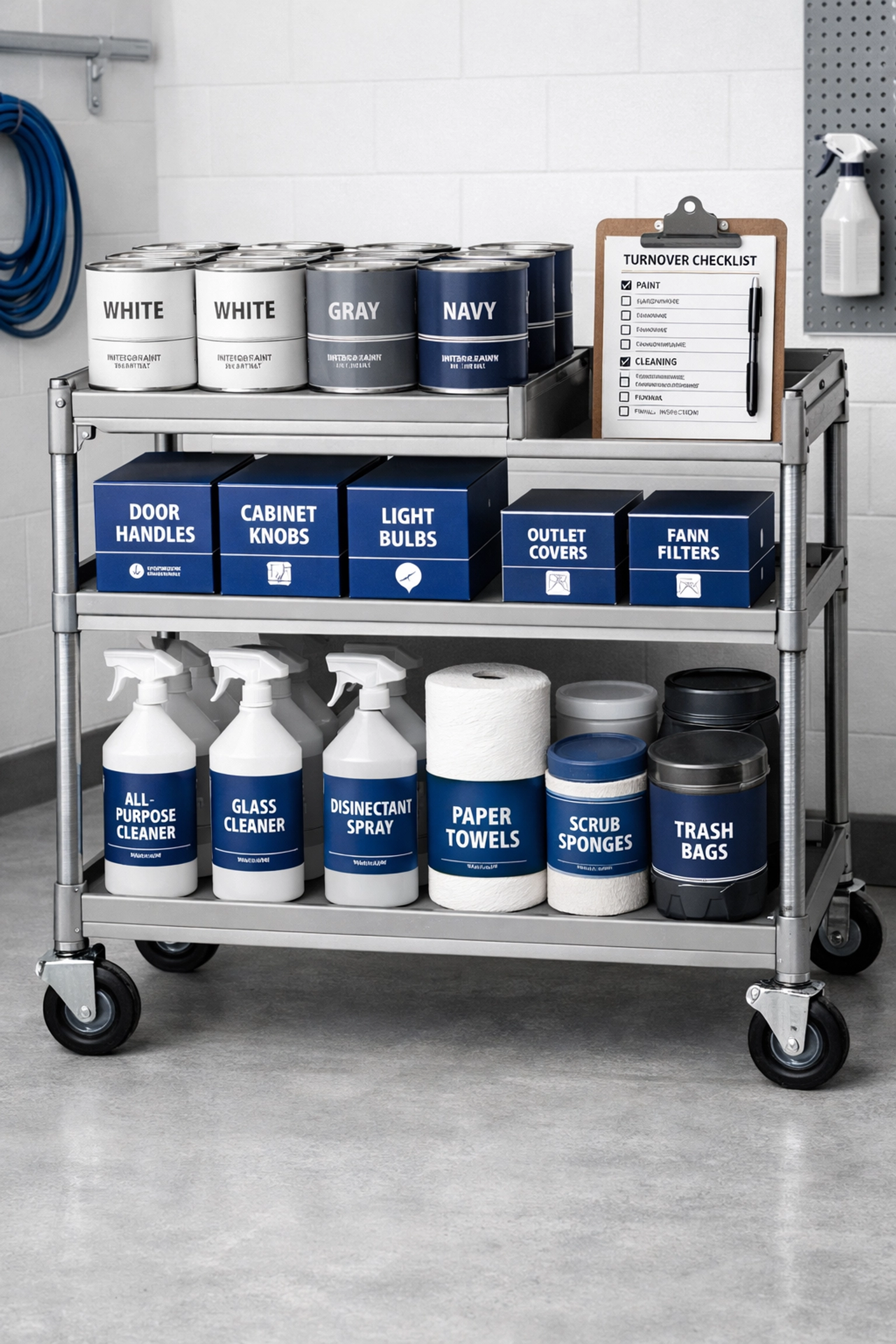
Create a standard turnover kit for each unit type:
- Exact paint quantities by color and finish
- Common replacement hardware
- Standard light fixtures
- Air filters
- Cleaning supplies
This eliminates the "we ran out of paint" delays that can add days to a turnover.
Strategy #6: One Unit, One Owner
Every single unit turnover needs one person responsible for shepherding it from move-out to move-in ready.
This person tracks where the unit is in the process, follows up with vendors, catches delays before they balloon, and signs off on final quality. When everyone shares responsibility, no one truly owns it.
Make it clear: "Sarah owns Unit 204's turnover. Mike owns 315." They're accountable for the timeline and the outcome.
When DIY Isn't Fast Enough
Sometimes you simply have more turnovers than your team can handle, even with all these optimizations in place.
If you're managing 100+ units, you'll hit peak turnover seasons where 5-10 units empty at once. Your in-house team can only do so much.
This is when professional turnover services make sense. The best ones can complete full turnovers in 24-72 hours because they have dedicated crews, established vendor relationships, and centralized coordination. You pay more per unit, but you eliminate vacancy losses that dwarf the service cost.
Think about it: spending an extra $500 on professional turnover versus losing $1,200 in vacancy costs because your team is backed up three weeks? Easy math.
Professional services work especially well for:
- Peak moving seasons (summer, end of lease cycles)
- Portfolio expansions where you're still building your team
- Geographic areas where you don't have enough density to justify full-time staff
The Speed-to-Market Advantage
Here's what most property managers miss: faster turnovers don't just reduce vacancy costs: they give you a competitive advantage.
When you can promise a move-in date within a week instead of two or three weeks, you attract better tenants. People with jobs, moving for work, families coordinating school schedules: they can't wait around. If your competitor's unit is available sooner, you lose the tenant.
Speed to market wins leases.

Start with One Change
You don't need to implement all six strategies tomorrow. Pick the one that addresses your biggest bottleneck right now.
If your turnovers drag because maintenance gets pulled in ten directions, start with Strategy #1: get someone focused on turnovers.
If you're constantly discovering broken appliances on move-out day, implement Strategy #2: preventive maintenance.
If different vendors keep showing up in the wrong order, fix Strategy #4: trade sequencing.
Make one change, measure the results, then add the next improvement.
Most property managers who implement even two or three of these strategies cut their average turnover time by 30-50%. That's real money back in your NOI, fewer frustrated prospects, and a lot less stress during peak moving season.
Your units don't need to sit empty for two weeks. With the right systems in place, you can cut that time in half: and keep cutting.
Categories: Property Management, Apartment Turnovers, Commercial Cleaning