


Category: Property Managers
Every day your apartment sits empty, you're losing money. At median rent rates, two weeks of vacancy costs you around $900 in lost income. That's not counting utilities, marketing costs, or the wear and tear on your nerves from wondering when the unit will finally rent.
The good news? Most property managers can cut their turnover time in half by fixing a few common bottlenecks. We're talking about getting units rent-ready in 7-10 days instead of 15-20. Here's exactly how to do it.
Why Turnover Speed Actually Matters
Look, we all know empty units don't pay bills. But it's more than that. In competitive rental markets, speed-to-market is everything. The fastest properties to market capture the best tenants at the highest rents. Meanwhile, properties that take three weeks to turn a unit are scrambling for whoever's left in the applicant pool.
The math is simple: faster turnovers mean more rental income, better tenant quality, and less stress on your maintenance team. Let's break down how to make it happen.

Step 1: Get Ahead of Move-Out Dates
The biggest mistake property managers make is waiting until move-out day to start planning. By then, you're already behind.
Here's what works: As soon as you receive a 30-day or 60-day notice, loop in your cleaning and maintenance teams. Give them the move-out date, schedule a pre-inspection if possible, and start lining up what needs to happen.
This gives everyone time to prepare. Your make-ready cleaning crew can block out their calendar. Your maintenance team can order parts they know they'll need. Your contractors can schedule around other jobs.
Pro tip: Create a shared calendar or notification system that automatically alerts your service providers when a tenant gives notice. No more playing phone tag or sending reminder emails.
Step 2: Maintain Units Year-Round (Not Just at Turnover)
The fastest turnovers happen when there's less work to do. Sounds obvious, but most properties only address maintenance issues when a tenant moves out or complains.
Switch to a preventive maintenance approach:
- Service HVAC systems every six months
- Check plumbing fixtures annually for leaks or wear
- Replace worn cabinet hardware before it breaks
- Touch up paint in high-traffic areas during the lease
Yes, this costs money upfront. But it removes items from your turnover checklist and prevents those "oh no" moments when you discover the water heater is shot and there's a three-day lead time on replacements.
One property manager we know dropped their average turnover time from 18 days to 9 days just by implementing quarterly preventive maintenance checks. The units were simply in better shape when tenants moved out.

Step 3: Standardize Everything with Checklists
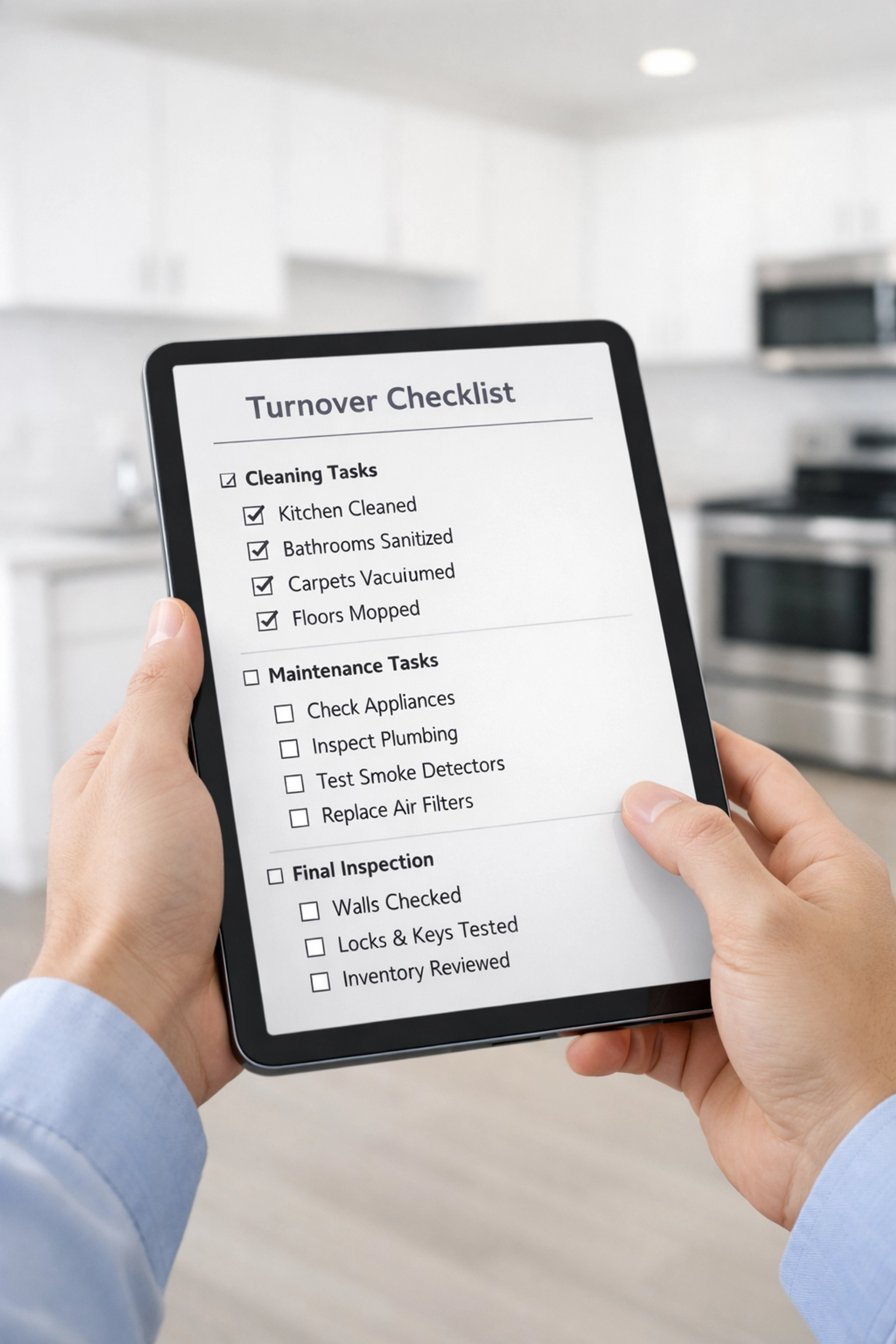
Every unit turnover shouldn't be a brand-new project where you're figuring things out from scratch. Create a master turnover checklist that covers:
- Deep cleaning tasks (kitchen, bathrooms, floors, windows, appliances)
- Standard repair items (patch holes, replace filters, touch up paint)
- Inspection requirements
- Photo documentation needs
Then take it a step further. Work with your cleaning and maintenance providers to pre-negotiate pricing for the 50 most common tasks. When you know that patching and painting costs $X, replacing a faucet costs $Y, and a full make-ready cleaning costs $Z, you eliminate all the back-and-forth.
No more waiting for quotes. No more surprise invoices. Just check the list, approve the work, and move forward.
The secret sauce: Your checklist should be task-specific, not vague. Don't write "clean kitchen." Write "clean inside all cabinets, degrease stovetop, clean inside oven, wipe down all appliances, sanitize countertops, clean sink and fixtures."
Step 4: Sequence Your Trades Like a Pro
Here's where most turnovers fall apart. You schedule the painter, the cleaner, and the carpet guy for the same week and hope they coordinate themselves. They don't. The painter shows up and can't work because the maintenance repairs aren't done. The cleaner finishes, then the electrician comes and makes a mess. The carpet installer arrives but the painting isn't dry.
Three extra days. Easy.
Instead, sequence your trades in the right order:
- Maintenance repairs first (plumbing, electrical, drywall repair, hardware replacement)
- Painting second (after repairs are done but before new flooring)
- Flooring third (carpet cleaning or replacement, vinyl, whatever's needed)
- Deep cleaning last (after all dusty, messy work is complete)
Schedule each phase back-to-back with minimal gaps. If the painter finishes on Tuesday, the flooring crew starts Wednesday, and the cleaning team comes Thursday. No three-day waiting periods between trades.
The best property managers treat turnover like a relay race. As soon as one team finishes, they hand the baton to the next team who's already ready to go.
Step 5: Use Technology to Track Progress
You can't manage what you can't see. If you're relying on text messages and phone calls to track where each unit stands in the turnover process, you're working too hard.
Use a maintenance management platform or even a simple shared spreadsheet that shows:
- What work has been completed
- What's currently in progress
- What's scheduled next
- Any delays or issues
This keeps everyone accountable and lets you spot problems early. If the carpet cleaning should've been done Tuesday and it's now Thursday with no update, you catch it immediately instead of three days later when it's a real problem.

Bonus benefit: When you can see all your turnovers in one place, you start noticing patterns. Maybe one contractor consistently runs late. Maybe certain repairs always take longer than expected. That data helps you make better decisions going forward.
The Make-Ready Cleaning Factor
Let's talk about the elephant in the room: cleaning quality. You can nail everything else, but if your make-ready cleaning isn't thorough and consistent, you'll fail final inspections and lose time.
A professional make-ready cleaning service does more than just make the unit look good. They work from a detailed checklist, they show up when scheduled, and they deliver consistent results. That predictability is worth its weight in gold when you're trying to hit aggressive turnover timelines.
Look for cleaning teams that specialize in turnovers and understand property management needs. They should be able to handle everything from standard cleanings to post-construction cleanup, and they should have backup crews available when you have multiple turnovers happening at once.
Putting It All Together
Cutting your turnover time in half isn't about working harder. It's about working smarter with better systems.
Start with one or two of these steps. Get ahead of your move-out dates. Build a standardized checklist. Improve your trade sequencing. Each improvement compounds.
The property managers getting consistent 7-10 day turnovers aren't superhuman. They just have better processes. They communicate earlier, coordinate better, and eliminate the little delays that add up to big vacancy periods.
And remember: every day you shave off your average turnover is money back in your pocket and one less thing keeping you up at night.

Ready to speed up your apartment turnovers? Professional make-ready cleaning is the foundation of faster unit turns. Learn more about our nationwide commercial cleaning services.